

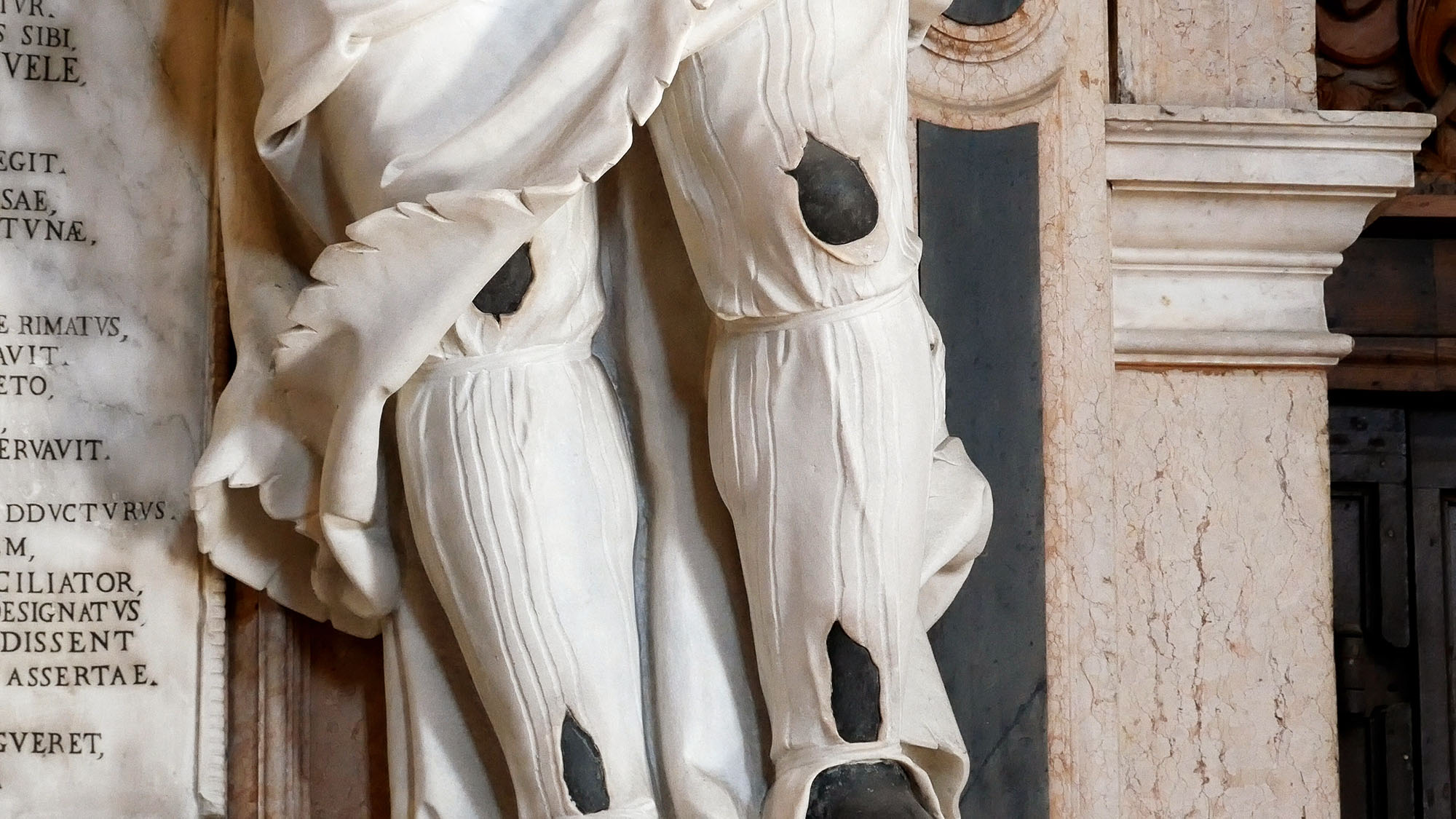
Axel Braun, Slaves (Baldassarre Longhena with G. Le Court, M. Barthel, F. Cavrioli and M. Fabris ‘The Pesaro Funerary Monument’, 1665–69, Basilica di Santa Maria Gloriosa dei Frari, Venice), 2024, UltraHD videos for 1/4/5 channel installation, each 00:02:30
While the splendour of self-representation peaked in the 17th century, the political power of the Venetian Republic was already in decline. Despite his brief term in office, Doge Giovanni Pesaro was immortalised by a two-storey sepulchral monument located in the Basilica di Santa Maria Gloriosa dei Frari. In the upper section, the Doge is surrounded by allegories that highlight his glory. Below are four telamon figures sculpted as racist stereotypes of African slaves, struggling to bear the weight of the ruler.
In 1690, the Giovanni Prati dedicated a poem to the monument that illustrates the perception of the time:
Sostien base Africana il Regio Duce,
Aggravata dal Genio, e non dal peso.
[The regal doge is supported by a plinth of Moors,
Bowing under his genius, and not his bulk.]
________________________________
Quotation and translation as in Stefano Colombo Baldassarre Longhena’s Funerary Monument to Doge Giovanni Pesaro, in: Word & Image, 35:1, 2019, pp. 48-65
Axel Braun, Doge (Baldassarre Longhena with G. Le Court, M. Barthel, F. Cavrioli and M. Fabris ‘The Pesaro Funerary Monument’, 1665–69, Basilica di Santa Maria Gloriosa dei Frari, Venice), 2024, UltraHD video, 00:02:30
From the early Middle Ages, the capturing, buying, shipping and selling of slaves was a substantial pillar of the emerging trade empire. While enslaving fellow Christians was already prohibited, pagan Slavs from the Balkans were among the first to be traded across the Mediterranean. At the time, there was a strong demand in Middle Eastern and North African societies for subjugated workers and warriors. Towards the end of the Middle Ages, slavery became less accepted in Romance-speaking Europe, but the devastating effects of the plague resulted in a return to earlier standards.
From the Renaissance onwards, artworks depicting African slaves and servants confirmed their owners’ status. Nevertheless, numerous wills illustrate that it was a widespread practice to free slaves after their masters’ death – which ensured them both the convenience of slavery during their lifetime and an unhindered transition to heaven.
This work was produced during an artist residency at Centro Tedesco di Studi Veneziani from April to June 2024. During my residence, I received a scholarship from the Federal Government Commissioner for Culture and the Media. Additionally, I am very grateful for a project grant from the Dr. Christiane Hackerodt Kunst- und Kulturstiftung.